
The Audi E5 is an exciting new China-market EV, but importing it to Europe is far more complex than its headline specs suggest. Charging compatibility is one issue, yet software, market positioning and sales restrictions are the bigger reasons why this story matters.
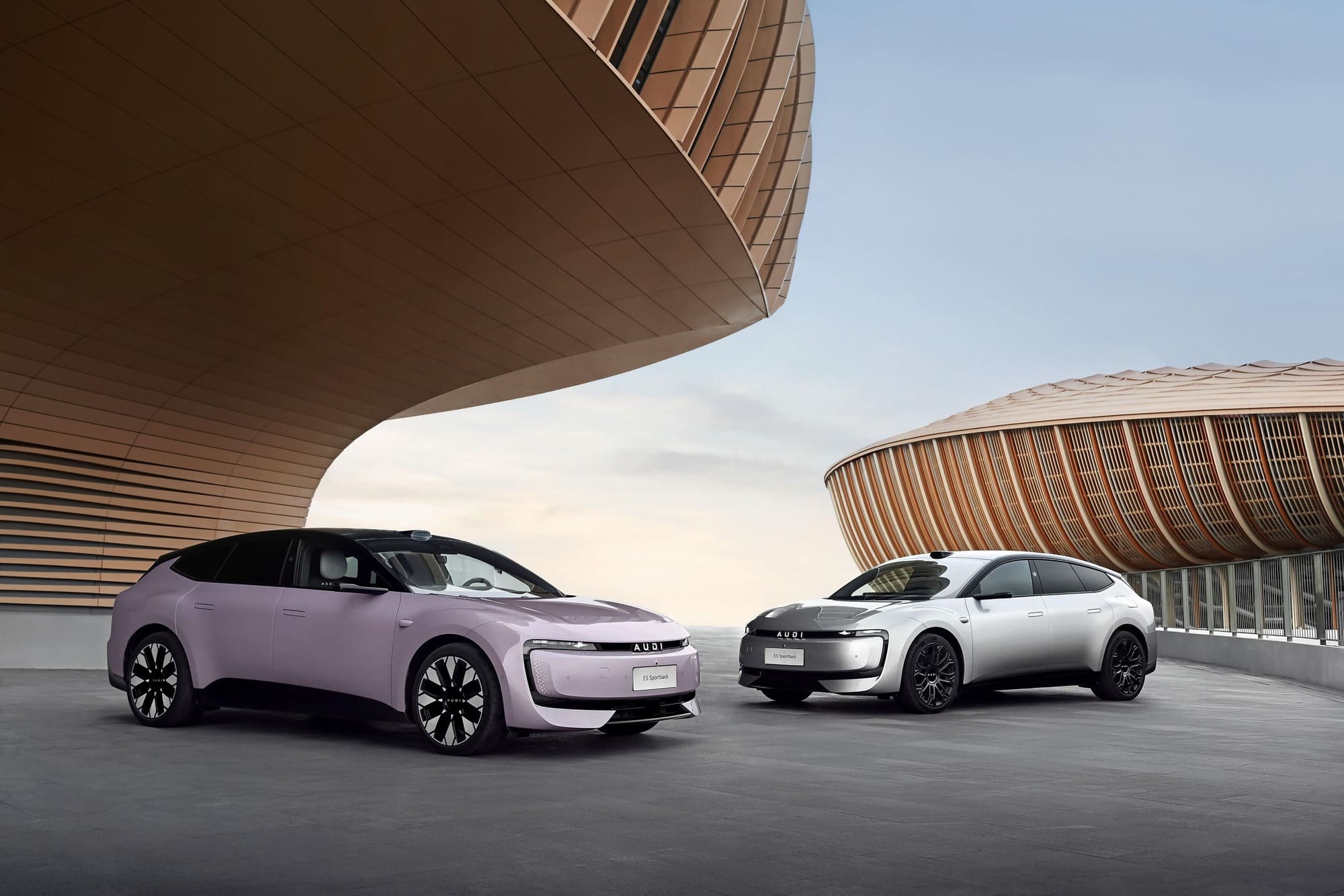
Audi positioned the E5 Sportback as the first production model of its new China-focused AUDI brand, and the official numbers are strong enough to spark real interest. But once you look beyond range and charging speed, the model also reveals how decisively Audi has tailored this car to a different ecosystem.
| Facts & Figures | |
|---|---|
| Public debut of the AUDI E5 Sportback | April 2025 |
| Start of series production in Anting, Shanghai | August 18, 2025 |
| Official battery capacity | Up to 100 kWh |
| Official quoted range | Up to 770 km (CLTC) |
| Official electrical architecture | 800 volts |
| Official fast-charge replenishment claim | Up to 370 km in 10 minutes |
Source: Audi: AUDI E5 Sportback – Production and pre-sales started in China
Audi E5: a China-market EV with real appeal
The Audi E5 is one of the clearest signs yet that Audi now treats China as a distinct product world, not just another sales region. The E5 Sportback debuted in April 2025 and entered series production in Anting, Shanghai, on August 18, 2025, as the first production model of the new China-focused AUDI brand. That matters because it frames the whole import debate: this is not simply an Audi from China, but a model developed around different infrastructure, different digital expectations and a different market logic.
On paper, the car is highly compelling. Audi officially quotes up to 100 kWh battery capacity, up to 770 km of CLTC range, an 800-volt architecture and fast-charging capability that can add up to 370 km in 10 minutes. Those are serious numbers, and they explain why the official E5 debut announcement drew attention far beyond China.
Why the charging issue is only the first problem
The first visible hurdle for a European import is charging. The Audi E5 is configured for China’s GB/T charging ecosystem, while Europe’s public DC infrastructure is built around CCS2. That is not a minor detail, because charging standards are not just about plug shape but also about communication between car and charger.
DIN describes Combo 2 as the interoperable DC standard used in Europe, which is exactly why a China-market EV cannot be treated like a plug-and-play import. At the same time, the GB/T charging standard overview shows how clearly the Chinese system stands apart. In practice, that means the charging question is broader than a cable adapter: compatibility, charging logic and dependable real-world usability all come into play.
Software, services and product policy are the real barriers
The software is even more important than the charging connector. Modern electric cars depend on many digital services. These include user accounts, navigation, apps, charging route planning and software updates. However, the E5 was developed mainly for the Chinese market. This raises an important question for European buyers. The car may be easy to import, but will its digital features work properly in Europe?
In addition, the E5 is part of Audi’s separate strategy for China. It was developed together with SAIC under the new AUDI brand. Therefore, the car is designed to meet the needs of Chinese customers. Although the technology may look attractive, importing the E5 to Europe comes with risks. For example, some digital services might not work as expected. As a result, owning this interesting electric car could become more complicated than buyers expect.
What enthusiasts can do instead of chasing an import
The commercial side has also become sharper. According to the facts provided for this brief, the manufacturer has obtained an interim injunction that forces independent importers to stop selling SAIC-Audi models with immediate effect. That changes the conversation from technical curiosity to legal and commercial reality, because even a buyer willing to accept charging and software compromises may now face a shrinking route to purchase.
If you are mainly interested in the Audi driving experience rather than the legal grey area of a China import, the smarter route is usually an officially supported experience. More on renting an Audi RS gives you access to the brand’s performance side without the ownership risks. That practical route is a much cleaner fit for enthusiasts who want seat time, not import headaches.
Why the Audi E5 matters beyond one model
The Audi E5 is therefore more than an intriguing electric fastback. It is a case study in how far Audi has decoupled its China strategy from its European lineup in platform execution, software thinking and user experience. As a product, it is genuinely interesting precisely because it appears so thoroughly designed for another market.
That is also the core lesson for potential import buyers in Europe. The challenge is not that the E5 lacks substance; on the contrary, its official specs make it look highly relevant. The challenge is that infrastructure, software and distribution rules all point in the same direction: this car makes the most sense inside the Chinese ecosystem it was built for.
The Audi E5 is fascinating precisely because it was engineered so consistently for a different market.
Conclusion
The Audi E5 shows just how far Audi has now separated its China strategy from its European program. As a product, the car is highly interesting precisely because its platform, software and user experience were developed so consistently for a different market.
That is why the fascination and the import risk exist at the same time. For enthusiasts in Europe, the E5 is worth watching closely as a signal of Audi’s wider strategy, but far less convincing as a straightforward ownership idea.
Frequently asked questions
Can you import the Audi E5 to Europe?
In principle, a private import is conceivable, but the practical hurdles are unusually high. The charging hardware is designed around China’s GB/T ecosystem, while Europe relies on CCS2, and software integration is the bigger issue because services, connectivity and digital functions are tailored to the Chinese market. On top of that, the manufacturer has reportedly forced independent importers to stop selling SAIC-Audi models with immediate effect via an interim injunction.
What charging standard does the Audi E5 use?
The Audi E5 is designed for the Chinese charging environment, which centers on the GB/T standard. In Europe, CCS2 is the dominant DC fast-charging standard, so a simple plug match cannot be assumed. Even if hardware adapters exist in theory, interoperability, communication protocols and certification remain critical in real-world use.
How much range and battery capacity does the Audi E5 have?
Audi officially states up to 100 kWh battery capacity for the E5 Sportback. The brand also quotes up to 770 km of range under the Chinese CLTC test cycle, which is not directly comparable to European WLTP values. Audi further cites an 800-volt architecture and up to 370 km of fast-charge replenishment in 10 minutes.
When did the Audi E5 launch in China?
The Audi E5 Sportback made its debut in April 2025 ahead of Auto Shanghai 2025. Series production in Anting, Shanghai, started on August 18, 2025, and Audi announced the start of pre-sales in China on the same date. That timeline underlines that this model was planned as a China-first product from the outset.