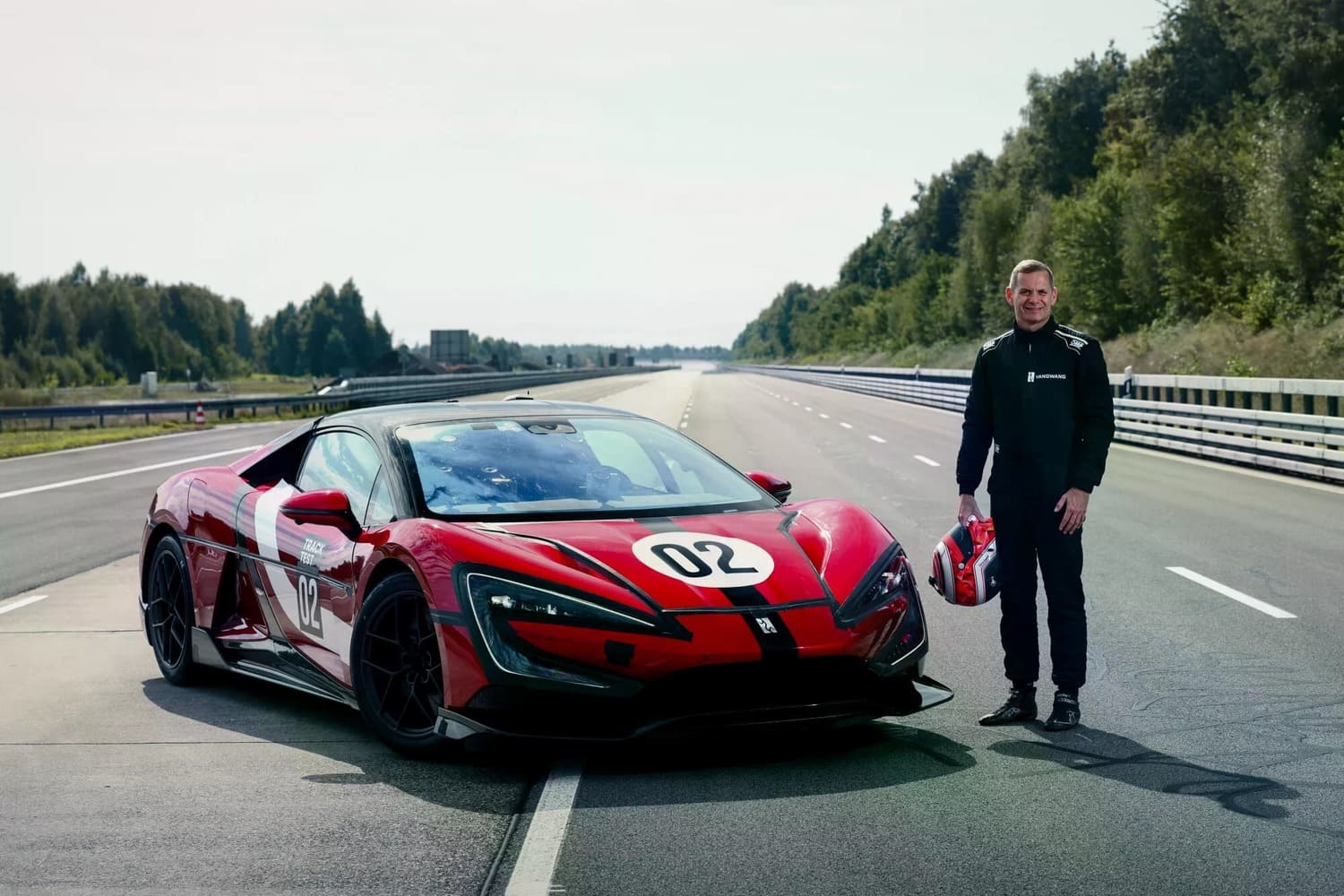

The Yangwang U9 Xtreme is suddenly headline news after a high-speed crash during testing near the 500 km/h threshold. More important than the shock value is what the incident reveals about a project that already pairs verified supercar numbers with an official 496.22 km/h top-speed claim and a 6:59.157 Nürburgring lap.
Behind the crash headline sits a serious technical story. The standard U9 already brings 960 kW, 1,680 Nm, a 2.36-second sprint to 100 km/h and an 80 kWh battery, while the Xtreme program shows how aggressively Yangwang is pushing into the outer edge of EV performance.
| Facts & Figures | |
|---|---|
| Standard Yangwang U9 output | 960 kW / 1,306 PS |
| Standard Yangwang U9 torque | 1,680 Nm |
| 0–100 km/h (standard U9) | 2.36 s |
| Standard Yangwang U9 battery capacity | 80 kWh |
| Officially communicated U9 Xtreme top speed | 496.22 km/h |
| U9 Xtreme Nürburgring Nordschleife lap | 6:59.157 min |
Source: Nürburgring Records: YANGWANG U9 Xtreme
Why the crash matters beyond the headline
The Yangwang U9 Xtreme has recently attracted attention after a high-speed crash during testing. The incident happened while the team was working towards the 500 km/h mark. As a result, the crash quickly became a major topic in the automotive world. However, the car was not simply trying to set another speed record. Instead, it was being tested at extremely high speeds. At these speeds, factors like aerodynamics, tire safety and road conditions become especially important. In addition, drivers have very little time to react. Therefore, even small problems can have serious consequences.
However, there is more to the story than just the crash. The Yangwang U9 Xtreme had already been linked to an officially reported top speed of 496.22 km/h. As a result, it came very close to reaching the 500 km/h barrier. Furthermore, the car had also achieved a lap time of under seven minutes on the Nürburgring Nordschleife. This shows that the project was not only focused on maximum speed. Instead, it also aimed to deliver strong performance on the racetrack. Overall, these achievements highlight the ambitious goals behind the Yangwang U9 Xtreme and its development.
The hard numbers behind the standard Yangwang U9
To understand the relevance of the Xtreme project, it helps to start with the road-going base car. According to BYD’s official launch information and the YANGWANG U9 data sheet, the standard Yangwang U9 delivers 960 kW, or 1,306 PS, and 1,680 Nm of torque. The claimed sprint from 0 to 100 km/h takes 2.36 seconds, while the battery capacity is listed at 80 kWh.
Those are not decorative figures. They establish the production U9 as a serious electric supercar before any Xtreme-specific tuning or aero work is even discussed. In other words, the crash story sits on top of a very real technical foundation, not a paper project invented for internet virality.
A 500 km/h target changes everything
The Xtreme version pushed the narrative much further. Yangwang publicly communicated a 496.22 km/h top speed for the Yangwang U9 Xtreme, a number that reframed the project from ambitious EV supercar to outright high-speed outlier. At that level, the final few km/h are never incremental in the usual sense. They demand a different level of confidence in aerodynamics, thermal management, chassis stability and the full vehicle system.
That is exactly why the recent test crash resonates so strongly. When a development car operates this close to 500 km/h, the margin between a historic achievement and a violent failure is microscopic. The incident does not prove the concept was misguided, but it does show just how uncompromising this engineering territory is.
The Nürburgring result gives the project credibility
There is another reason the Xtreme project cannot be dismissed as a straight-line publicity exercise. On August 22, 2025, the car recorded a 6:59.157-minute Nordschleife lap, as documented on the official Nürburgring records page and in the corresponding Nürburgring news release. Breaking the seven-minute barrier on the Nordschleife matters because it gives the program a circuit-based reference, not just a maximum-speed soundbite.
That lap time also changes the way enthusiasts should read the crash. A machine capable of that Nordschleife result is clearly being developed with broad dynamic ambition. The top-speed run may grab more attention, but the Nürburgring performance suggests the Xtreme was designed to prove legitimacy across multiple performance metrics.
From headline speed to real driving experience
For drivers who want to experience what serious performance engineering feels like in the real world, the smarter route is not a 500 km/h record chase but a controlled track environment. That is where DRIVAR’s race car rental and Nürburgring track experiences make sense: clear procedures, professional surroundings and a format built around manageable speed, instruction and safety rather than spectacle.
If stories like the Yangwang U9 Xtreme fascinate you, the practical next step is to get closer to performance driving in a way that is accessible and structured. Driving on track or booking a dedicated track-day car gives you a far better understanding of braking zones, weight transfer and commitment than any crash clip ever could.
Our take: the crash changes the optics, not the relevance
The immediate takeaway is simple: the high-speed crash has pushed the Yangwang U9 Xtreme into global conversation, but it has not reduced the project’s technical significance. If anything, it highlights the severity of the challenge. A car operating this close to 500 km/h is no longer playing in the familiar supercar space. It is entering a development zone where small variables carry enormous consequences.
That is why the current moment matters. The standard U9 already brings verified production-car figures, and the Xtreme has paired its 496.22 km/h headline with a 6:59.157 Nordschleife lap. Against that backdrop, the crash feels less like a contradiction and more like a harsh reminder of what happens when engineering pushes right up against the limits of physics.
At nearly 500 km/h, every test run stops being a headline stunt and becomes a lesson in physics, safety and engineering margins.
Conclusion
The current high-speed crash has thrown the Yangwang U9 Xtreme into the spotlight overnight, but it does not diminish the technical relevance of the program. If anything, it reinforces it.
Precisely because the car is operating so close to the 500 km/h mark, the incident shows how uncompromising this development zone really is. That tension between breakthrough and risk is exactly what makes the Yangwang U9 Xtreme one of the most closely watched performance projects right now.
Frequently asked questions
What happened in the Yangwang U9 Xtreme high-speed crash?
The crash happened during a high-speed test run as Yangwang continued development work close to the 500 km/h threshold. Publicly available footage and reporting show a violent loss of control, but the bigger point is that the program was operating in one of the most demanding zones in vehicle testing. The incident does not erase the car’s verified speed and lap-time achievements, but it does underline how extreme this development target really is.
How fast is the Yangwang U9 Xtreme officially?
The officially communicated top speed for the Yangwang U9 Xtreme is 496.22 km/h. That places it right on the doorstep of the 500 km/h milestone, which is why the project has drawn so much attention. It is important to separate that confirmed figure from speculation around future runs beyond 500 km/h.
What are the specs of the standard Yangwang U9?
The production Yangwang U9 is rated at 960 kW, which equals 1,306 PS, and 1,680 Nm of torque. Yangwang states a 0–100 km/h time of 2.36 seconds and an 80 kWh battery capacity. Those figures already put the road car into genuine hypercar territory, even before the Xtreme program enters the picture.
Did the Yangwang U9 Xtreme set a Nürburgring record?
Yes. The Yangwang U9 Xtreme posted a Nordschleife lap of 6:59.157 minutes. That made it one of the headline EV performance stories of 2025 and gave the project credibility beyond top-speed marketing alone.