Mercedes C111 auction: a prototype icon goes on sale
 By Florentina Blakaj
7 min read
The Mercedes C111 is heading to auction for the first time ever, with RM Sotheby’s set to offer the prototype icon in Paris on February 3, 2027. For enthusiasts, that makes this far more than another collector-car sale: it is the first real chance to buy one of Mercedes-Benz’s most elusive engineering legends.
What makes the story especially compelling is that the C111 was never a production car and never a normal concept. It was a fully developed prototype, later associated with Bruno Sacco, built to test advanced ideas and ultimately preserved as part of the brand’s myth rather than its sales history.
| Facts & Figures | |
|---|---|
| Total Mercedes C111 models built | 17 vehicles |
| Cars known to survive today | 13 examples |
| Auction date in Paris | February 3, 2027 |
| Output of the four-rotor Wankel engine | 257 kW / 350 PS |
| Top speed of the C111-II | Up to 300 km/h |
| Wankel engine chamber volume | 4 x 602 cm³ |
Source: Mercedes-Benz Media: C 111 erstmals auf dem Markt
Mercedes C111 heads to auction for the first time
The Mercedes C111 is about to make automotive history. On February 3, 2027, one of these legendary prototypes will be auctioned in Paris for the first time. However, this is more than just another classic car auction. The C111 was never a regular production car. Instead, Mercedes-Benz developed it as an experimental vehicle to test new technologies and engineering concepts. As a result, it was never available to private buyers. For decades, enthusiasts could only admire the C111 at exhibitions, museums and classic car events.
Furthermore, the Mercedes C111 is exceptionally rare. Mercedes-Benz built only 17 vehicles in total, and just 13 examples are known to survive today. Because of this, the upcoming auction is particularly significant for collectors and automotive enthusiasts. While many legendary classic cars occasionally appear on the market, the C111 has remained out of reach. Until now, it was better known for its engineering innovations than its market value. Therefore, the auction represents a unique opportunity to own a piece of Mercedes-Benz history. At the same time, it marks a new chapter in the story of one of the most fascinating automotive prototypes ever built.
Prototype drama, Wankel power, real mileage
The car itself adds even more weight to the story. It is a Weißherbst-colored C111-II carrying chassis number 6411612797/3, and it has covered just under 25,000 kilometers. Under its dramatic bodywork sits the four-rotor Wankel engine that defines the model’s legend, with a chamber volume of 4 x 602 cm³ and output of 257 kW, or 350 PS.
Mercedes-Benz quoted a top speed of up to 300 km/h for the C111-II, numbers that were extraordinary for the early 1970s and still sound serious today. The car offered by RM Sotheby’s is also described with period-correct details that underline its prototype character rather than any production-car polish. Inside, it features sports seats trimmed in grey-and-white houndstooth, a four-spoke steering wheel and a vertically mounted Becker radio.
More than a concept: what the C111 really was
Its backstory matters just as much as the raw specification. The auction car was assembled beginning in March 1970 and used by Mercedes-Benz for development work and testing during the period when the company was seriously exploring rotary-engine technology. Depending on use, the car ran on 8×15-inch aluminum wheels or on magnesium wheels sized 10×15 inches at the front and 13×15 inches at the rear, with those wheels also due to be auctioned in Paris.
This helps explain why the Mercedes C111 should not be mistaken for a design study alone. It was not a styling mock-up and not a thinly disguised production preview. It was an active engineering tool, a prototype in the truest sense, created to test ideas, gather data and push Mercedes-Benz into technical territory that conventional road cars of the time could not reach.
Why the Mercedes C111 became a legend instead of a series car
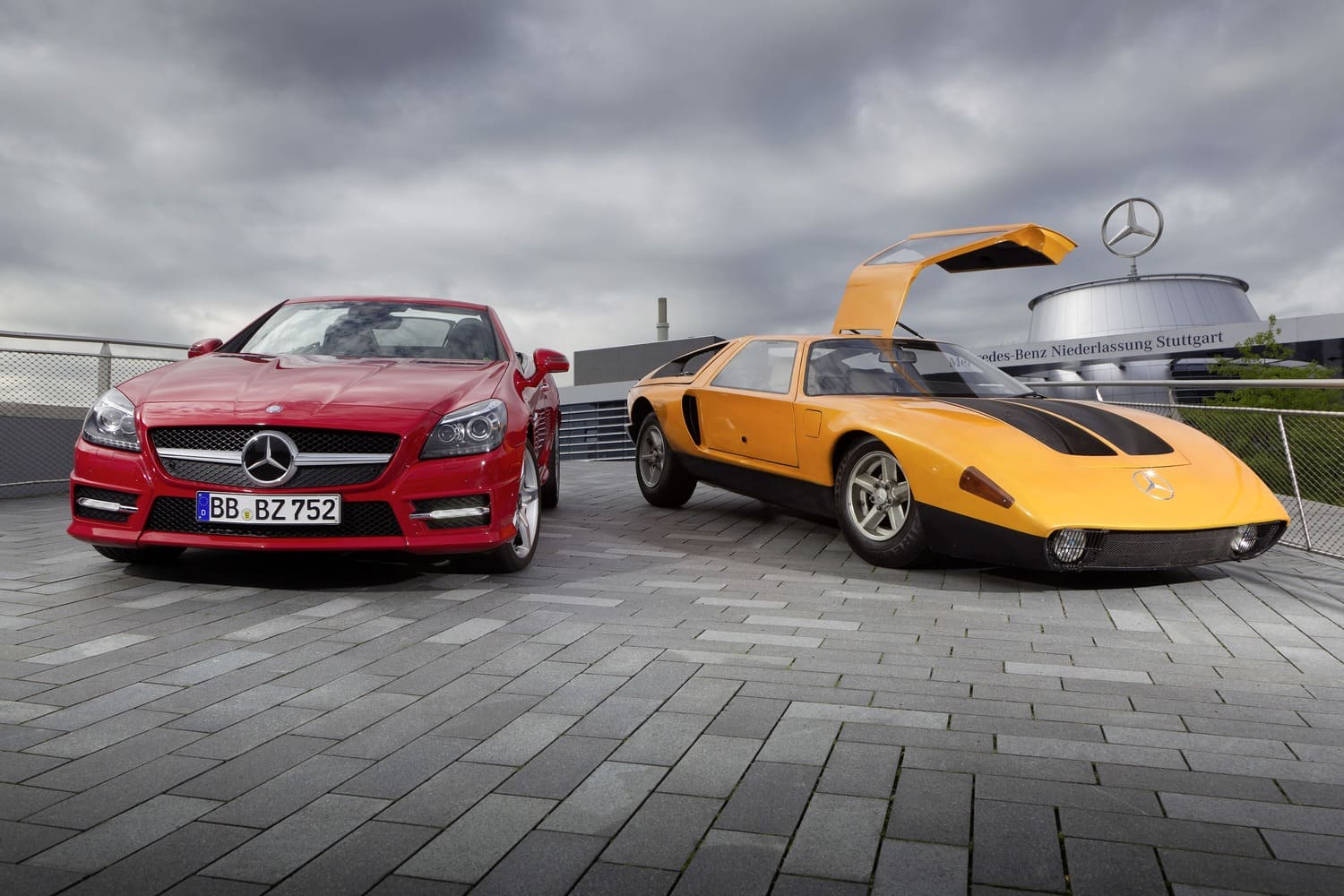
The shape remains one of the strongest reasons the C111 still hits so hard visually. Mercedes-Benz links the project to Bruno Sacco, who would later become the brand’s chief designer, and that connection gives the car an additional place in design history. Even now, the wedge profile, low roof and clean surfacing look less like nostalgia and more like a vision of a future that almost happened.
That future, of course, never became a production reality. Despite huge public interest, the C111 was never sold new, and Mercedes-Benz eventually chose not to put it into series production. After its testing duties and the famous record runs of the late 1970s, the surviving cars became stars of exhibitions and oldtimer events, reinforcing the idea that the Mercedes C111 belonged to company history rather than the collector market.
From unreachable icon to real-world driving emotion
For enthusiasts, that distance is part of the fascination. Most people will never bid on a prototype like this, and the final auction price is impossible to predict with any confidence. Yet the appeal is easy to understand if you have ever wanted to get closer to machines that shaped performance-car culture, whether through a historic icon on display or by driving something equally emotional in the real world.
That is exactly where DRIVAR speaks to the same instinct from a different angle. If a car like the C111 reminds you why rare engineering experiments still matter, exploring a modern supercar experience or browsing a broader selection of sports cars is the practical way to turn admiration into seat time. You do not need a museum collection or an auction paddle to experience speed, occasion and the sense that some cars are meant to be felt, not just discussed.
Why this Paris sale matters beyond the hammer price
There is also a deeper reason this sale resonates beyond collectors. The C111 sits at a crossroads of technology, design and corporate memory, which is why its transition from museum-grade artifact to auction lot feels so significant. A car once treated as untouchable is suddenly entering the open market, even while its historical aura remains fully intact.
That is the paradox that makes this story so compelling. The upcoming auction makes the Mercedes C111 feel more tangible than ever, but at the same time even more mythical. For the first time, a vehicle long regarded as an inaccessible piece of Mercedes-Benz history will actually be offered for sale, and that changes the conversation around the car forever.
For the first time, the Mercedes C111 becomes buyable—and somehow even more mythical in the process.
Conclusion
The Mercedes C111 has always occupied a strange and fascinating space in automotive history: famous, influential and instantly recognizable, yet never truly obtainable. That tension is exactly what made the car special for decades.
Now the upcoming Paris auction changes the picture without reducing the mystique. For the first time, a vehicle once seen as an untouchable part of Mercedes-Benz history will be offered publicly, making the C111 more reachable in theory and even more mythical in practice.
Frequently asked questions
When is the Mercedes C111 auction taking place?
The first public sale of a Mercedes C111 is scheduled for February 3, 2027, in Paris during RM Sotheby’s auction alongside Rétromobile week. That date matters because Mercedes-Benz has never previously offered a C111 for private purchase. For collectors and enthusiasts, it turns a long-untouchable prototype into a real auction lot for the first time.
How many Mercedes C111 cars were built?
Mercedes-Benz built 17 examples of the C111 family in total. According to the confirmed figures provided for this story, 13 of those cars still exist today. That rarity is a major reason why the upcoming auction has attracted so much attention.
How powerful was the Mercedes C111-II?
The auction car is powered by a four-rotor Wankel engine rated at 257 kW, or 350 PS. Its chamber volume is 4 x 602 cm³, and the C111-II was capable of speeds up to 300 km/h. Those numbers made it one of the most technically ambitious German prototypes of its era.
Was the Mercedes C111 ever sold new to customers?
No, the Mercedes C111 was never a series-production model and was never available to buy new. It was developed as a prototype and technology test car rather than a showroom product. That is exactly why this first auction appearance feels so unusual and historically important.
Sources & further reading
- Mercedes-Benz Media: C 111 erstmals auf dem Markt
- Mercedes-Benz Media: C 111-II Premiere 1970
- Mercedes-Benz Media: Bruno Sacco
- RM Sotheby’s: 1970 Mercedes-Benz C 111-II
- Title Picture: Mercedes Benz Group, 2026