
Xiaomi SU7 is one of the most intriguing new electric performance sedans on the market, but for German buyers the key question remains simple: when will it actually arrive? Right now, the clearest answer is that Xiaomi has publicly pointed to an overseas EV push in 2027, with Europe named as the first major target market.
Even before any official German launch date exists, the SU7 has built real momentum through its low-slung design, headline performance figures and Xiaomi’s broader tech ecosystem. That combination makes it relevant well beyond China, especially for drivers in Germany who normally cross-shop cars like the Porsche Taycan and Tesla Model 3 Performance.
| Facts & Figures | |
|---|---|
| World debut | December 28, 2023 |
| China market launch | March 28, 2024 |
| Length / width / height | 4,997 / 1,963 / 1,455 mm |
| Wheelbase | 3,000 mm |
| Drag coefficient | 0.195 |
| Overseas EV target | 2027 |
Source: Xiaomi Global – Xiaomi SU7: A Revolutionary EV Experience
Why the Xiaomi SU7 matters in the first place
The Xiaomi SU7 is not just another EV startup project. It is Xiaomi’s first production car, officially unveiled in late December 2023 and launched in China on March 28, 2024, which immediately gave the brand a serious place in the global EV conversation. For a company best known for smartphones and connected devices, that alone is a bold move.
What makes the car stand out is the way it mixes familiar sports-sedan proportions with very modern EV packaging. Xiaomi presents the SU7 as a full-size high-performance eco-technology sedan, and the official design story backs that up with a very low drag coefficient of 0.195 and a cab-rearward silhouette that looks more like a driver’s car than a rolling gadget. In a segment that can feel visually generic, the SU7 has genuine presence.
Design and first impression: sleek, low and surprisingly mature
Seen in profile, the Xiaomi SU7 looks long, planted and unusually resolved for a first car. Official dimensions place it at 4,997 mm in length, 1,963 mm in width and 1,455 mm in height, with a 3,000 mm wheelbase, which explains the stretched stance and the strong visual balance between nose, cabin and rear haunches.
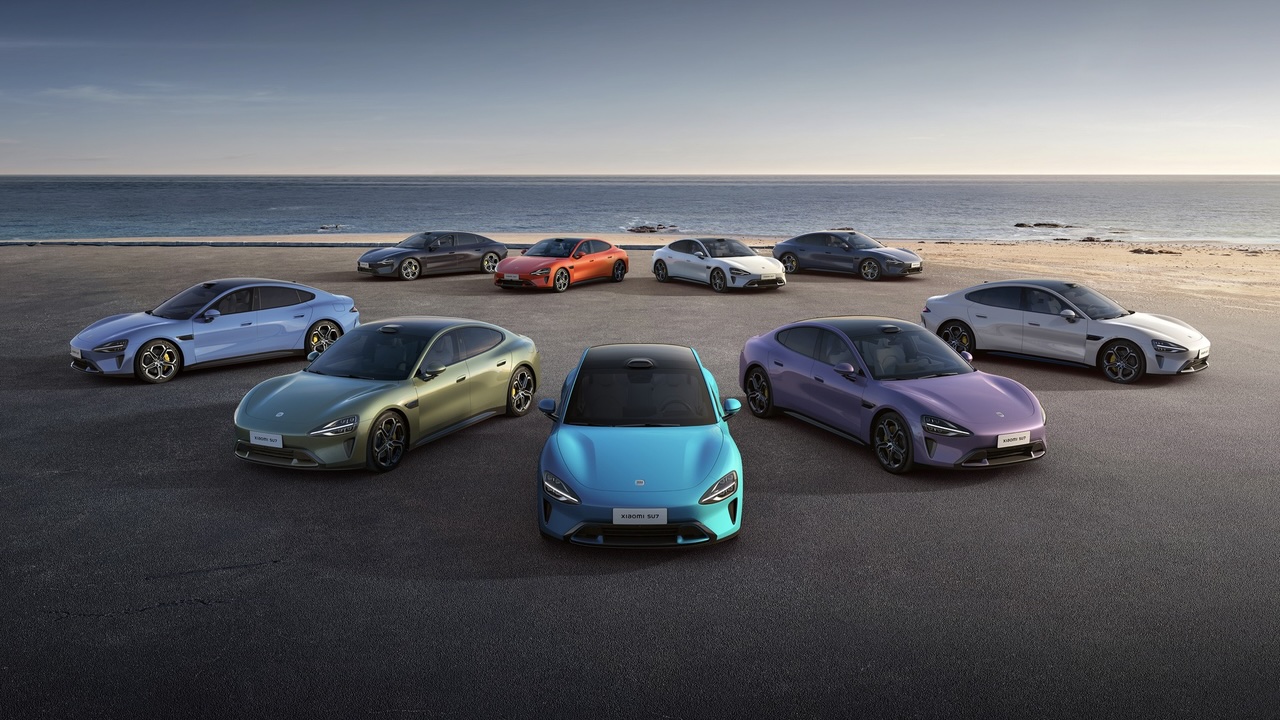
That sense of proportion matters because it gives the SU7 credibility before you even talk about battery size or software. The car’s waterdrop-style headlights, compact ducktail rear spoiler and halo taillights are distinctive without becoming fussy. Bild 1, showing the different body colors, underlines another point: Xiaomi understands that emotional appeal still matters in an electric sedan, and the SU7’s palette helps it feel more like an enthusiast product than a pure tech statement.
Cabin, interface and the tech-first character
Inside, the Xiaomi SU7 follows a clear digital-first philosophy, but not an empty one. Xiaomi’s official material highlights a 16.1-inch 3K central display, a 56-inch head-up display and a 7.1-inch rotating instrument cluster, creating a cabin that is deliberately built around information flow and connected-device integration.
That approach will appeal to some drivers more than others. If you love clean interfaces and seamless ecosystem logic, the SU7 feels consistent with Xiaomi’s wider “Human x Car x Home” idea. If you prefer the tactile clarity of a more traditional sports sedan, you may wonder whether the software takes too much visual priority. Either way, the interior clearly positions the SU7 as more than a value play; it wants to feel advanced, premium and future-facing.
Performance and driving feel: this is where the hype comes from
On paper, the SU7 absolutely has the numbers to spark interest in Germany. Xiaomi states that the regular SU7 range includes versions with up to 673 PS and 838 Nm in the Max variant, alongside a 0–100 km/h time of 2.78 seconds and a top speed of 265 km/h. Even if you set marketing excitement aside, those are serious figures.
There is also substance in the charging story. Xiaomi says the SU7 Max can recover up to 510 km of CLTC range in 15 minutes under ideal conditions, which is one reason the car has been discussed as a genuine high-performance daily rather than a niche halo product. The harder question, of course, is how those Chinese-market figures would translate to German autobahn use, European homologation, and eventual WLTP certification. Until a Europe-spec version exists, that remains an informed expectation rather than a settled fact.
When is the Xiaomi SU7 coming to Germany?
As of July 23, 2026, Xiaomi has not announced a fixed on-sale date for Germany. The most concrete public timeline is that Xiaomi management said in March 2025 that the company aims to sell EVs in overseas markets by 2027, and later reporting around Xiaomi’s overseas preparation indicated that Europe is intended to be the first stop for that expansion.
That does not mean the Xiaomi SU7 will automatically land in Germany on January 1, 2027. It means 2027 is the current strategic target for Xiaomi’s broader overseas EV push, with Europe central to that plan. There are also signals that preparation is real rather than theoretical, including reports of an SU7 Ultra experimental vehicle carrying a German license plate in 2025. Still, until Xiaomi confirms market-specific homologation, dealer structure, pricing and aftersales support, any narrower launch window would be speculation.
What a German launch would need to succeed
Germany is not just another checkbox market for an ambitious EV brand. If Xiaomi wants the SU7 to work here, it will need credible European type approval, a convincing service network, transparent warranty terms and charging compatibility that feels effortless in everyday use. Enthusiasts may be drawn in by acceleration and styling, but long-term trust is built through ownership basics.
That is why the European timeline matters more than headline hype. Xiaomi’s own executives have described Europe as a difficult but important first overseas market, which is a realistic reading of the challenge. For German buyers, the car only becomes truly relevant once it is not just fast on paper, but fully usable, supportable and legally straightforward in the local market.
From screen dream to real experience: what DRIVAR readers should do now
If the Xiaomi SU7 has caught your attention, the bigger takeaway is this: performance EVs are evolving fast, and the emotional gap to classic sports sedans is shrinking. Until Xiaomi officially launches in Germany, the smartest move is not to wait passively for a press release but to keep driving and comparing the cars that already define the segment here.
At DRIVAR, you can experience performance-focused cars in the real world instead of judging them only by online specs. That matters because speed figures tell only part of the story; seating position, steering response, visibility, braking feel and long-distance comfort are what shape your verdict once the road opens up. If Xiaomi eventually brings the SU7 to Germany, it will enter a market where drivers already know exactly what they expect from a serious fast car.
The Xiaomi SU7 is no longer a curiosity from China; it is a serious EV that now needs a serious European rollout.
Conclusion
The Xiaomi SU7 has already done the hard part of any new car launch: it made people pay attention for the right reasons. Its design is clean, its technical data is strong, and its market momentum in China shows that Xiaomi is not treating the automotive business as a side project.
For Germany, however, the decisive step is still ahead. Based on Xiaomi’s public comments, 2027 is the most realistic reference point for a European market entry, but no confirmed German sales date exists yet. If that launch comes together with proper homologation, support and pricing, the SU7 could become one of the most interesting new EV entrants on the German market.
Frequently asked questions
When will the Xiaomi SU7 come to Germany?
There is currently no officially confirmed on-sale date for Germany. The clearest public guidance is Xiaomi’s stated aim to begin selling EVs in overseas markets in 2027, with Europe identified as the first major target region. A German launch is therefore plausible from 2027 onward, but not yet fixed.
Is the Xiaomi SU7 officially confirmed for Europe?
Europe has been identified by Xiaomi management and subsequent reporting as the first major overseas market for the company’s EV expansion. That is an important signal, but it is not the same as a confirmed retail launch date or a full country-by-country rollout plan. For Germany, the key missing pieces are homologation, sales structure and aftersales details.
How powerful is the Xiaomi SU7?
Depending on version, the Chinese-market Xiaomi SU7 offers strong performance figures. Xiaomi has communicated outputs up to 673 PS and a 0–100 km/h sprint of 2.78 seconds for the SU7 Max. Those numbers explain why the car is taken seriously as a performance EV, not just as a tech product on wheels.
Is the Xiaomi SU7 a rival to Porsche and Tesla?
In attention terms, yes, because its shape, acceleration and positioning place it near the conversation around cars like the Porsche Taycan and Tesla Model 3 Performance. In market reality, that comparison only becomes fully relevant in Germany once Xiaomi actually launches the car locally. Right now, it is more accurate to call the SU7 a potential future rival than an established one.