
The Tesla Roadster 2026 event combined a 0–60 mph manufacturer demo in 0.81 seconds with active aerodynamics, an underbody suction system and a Rocket demonstrator using ten cold-gas thrusters. Tesla presented the spectacle live on October 15, 2026, making it more than a random AI clip, although crucial performance claims still await independent verification.
The “2026” label refers to the reveal rather than the production model year: Tesla currently targets 2028 for manufacturing. What appeared on stage was the company’s most direct fusion of electric-supercar engineering and SpaceX-inspired pressure technology so far.
| Facts & Figures | |
|---|---|
| Roadster event | October 15, 2026, local time |
| Announced variants | Performance, Thrust and Rocket |
| Rocket demonstrator | 10 cold-gas thrusters; approximately 600 liters |
| 0–60 mph | 0.81 seconds, manufacturer demonstration |
| Announced top speed | More than 230 mph / approximately 370 km/h |
| Production start | 2028, planned |
Source: Official Tesla Roadster event livestream
What happened at the Tesla Roadster 2026 event?
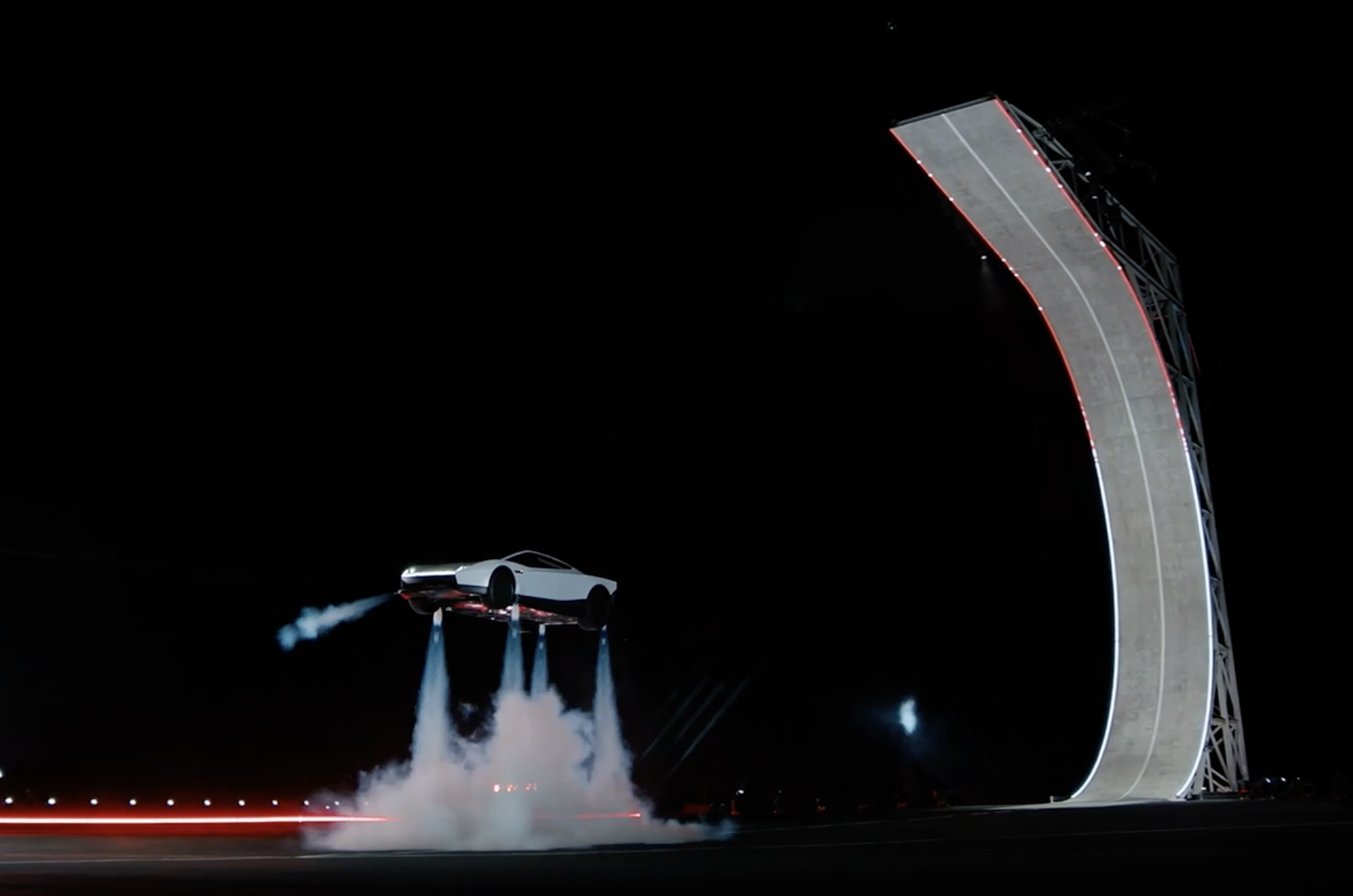
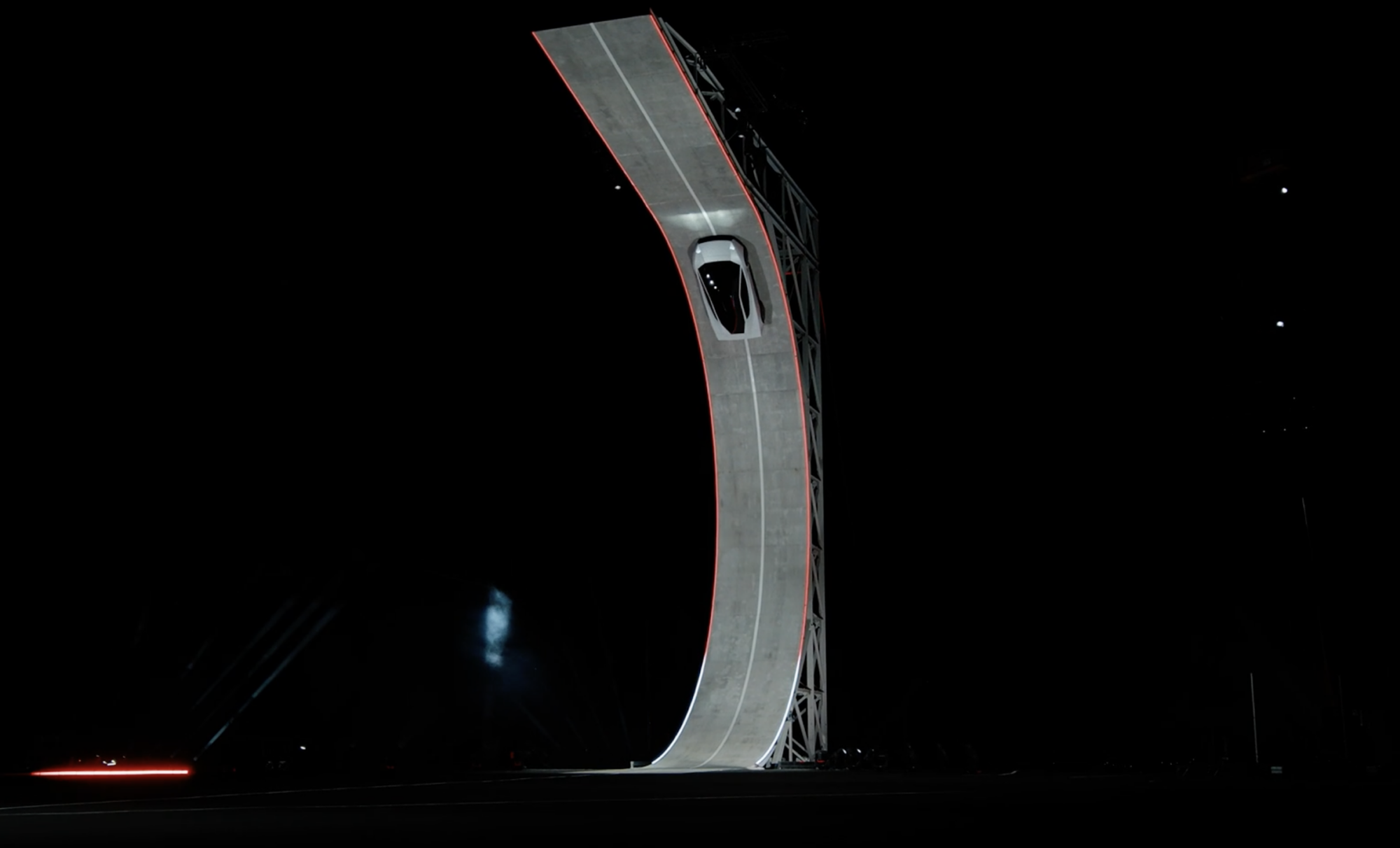
The Roadster event took place on October 15, 2026, local time and was built around physical demonstrations rather than a conventional studio presentation. Tesla used the show to introduce the Performance, Thrust and Rocket variants, while the official Roadster livestream provided the full context behind the short clips that subsequently spread across social media. The event image shown here captures the theatrical setting that made the reveal feel closer to an aerospace test than a normal vehicle premiere.
The headline number was a manufacturer-demonstrated 0–60 mph run in 0.81 seconds. Tesla also announced a top speed exceeding 230 mph, equivalent to roughly 370 km/h, but neither figure has yet been confirmed by an independent test of a production vehicle. That distinction matters: the car on stage was a highly specialized demonstrator, not a homologated customer Roadster.
Ten thrusters and a 600-liter pressure system
The Rocket demonstrator reportedly combines ten cold-gas thrusters with approximately 600 liters of storage volume. Cold-gas propulsion does not burn fuel like a conventional rocket engine; it releases pressurized gas through nozzles to generate a short, controllable force. The principle is familiar from spacecraft attitude-control systems, but packaging it inside a passenger-car-sized platform creates major challenges involving pressure vessels, thermal management, repeated operation and crash protection.
This is where the Tesla and SpaceX connection becomes technically meaningful rather than merely promotional. The system can use thrust to supplement tire traction during acceleration and, in the most extreme demonstration configuration, influence the vehicle while airborne. Tesla has not published the demonstrator’s curb weight, battery capacity, power output or complete pressure-system specifications, so calculations about sustained flight or repeatable performance would currently be speculation.
The announced hierarchy suggests three increasingly radical interpretations of the same platform. Performance introduces the active aerodynamic and suction concepts, Thrust adds more aggressive propulsion for acceleration, and Rocket represents the complete ten-thruster showcase. Tesla’s official Roadster page remains the main reference for availability and specification updates as the project develops.
Tesla Roadster 2026 Track Mode explained
The Roadster’s second major engineering story is its combination of active aerodynamics and an electrically generated vacuum beneath the car. A fan-based suction system can reduce pressure under the floor and create downforce without relying entirely on vehicle speed. In theory, that gives the car additional grip during low-speed cornering, braking and acceleration, where a conventional wing generates relatively little aerodynamic load.
Tesla’s original Track Mode video on X shows the Roadster changing shape as aerodynamic elements move into position.
Real life, baby https://t.co/3QEqn18wig
— Tesla (@Tesla) October 16, 2026
The company says the wing actuation is driven by its Optimus actuator system and describes the package as approaching Formula 1 levels of downforce. That remains a manufacturer claim, but the visible transformation provides a useful look at how the demonstrator manages airflow rather than treating its movable surfaces as decorative theatre.
The second event image underlines how much the new shape has moved beyond the smoother Roadster concept first presented years earlier. Large openings, deployable components and a highly managed underbody are consistent with a machine intended to combine mechanical suction, aerodynamic load and short bursts of gas propulsion. The engineering challenge will be making those systems durable, predictable and legal outside a controlled demonstration.
Real demonstration or AI slop?
The spectacular footage immediately triggered the obvious question: was it real, or simply AI slop? Tesla answered the debate with the caption “Real life, baby” and published the original Roadster stunt video on X. More importantly, the core demonstration formed part of the company’s streamed event rather than appearing only as an isolated, context-free promotional clip.
That does not mean every claim should be accepted without scrutiny. Social-media videos are edited presentations, and the livestream does not replace independent timing equipment, technical inspection or repeat testing. Tesla has also not provided raw onboard data that would allow outsiders to reconstruct the forces, speeds and thruster inputs involved.
The most reasonable verdict is therefore more nuanced than either “obvious fake” or “production-ready flying car.” The event itself and the physical demonstrator were real, while the videos present carefully selected views of an experimental machine operating under controlled conditions. There is currently no convincing basis for dismissing the entire demonstration as AI-generated, but there is also not enough independent evidence to treat every performance implication as proven.
The long road from show car to 2028 production
Tesla has set 2028 as the planned start of Roadster production. In practical terms, that leaves substantial work between the 2026 show and a customer-ready vehicle, particularly for the Rocket configuration. Pressure-vessel safety, noise, pedestrian protection, system redundancy and predictable operation will all influence which functions can be approved for public roads and in which markets.
There is also a fundamental difference between surviving a rehearsed stunt and delivering repeatable performance over years of normal ownership. Active wings require reliable actuators and fail-safe positions, while an underbody suction system must cope with debris, water and irregular surfaces. A cold-gas system adds high-pressure hardware that must remain safe during servicing and collisions.
For now, the 0.81-second sprint is best understood as a manufacturer demonstration rather than a final production specification. The same caution applies to the claimed 230-plus-mph top speed. The Roadster has shown what Tesla wants the platform to become; certification, independent testing and series-production hardware will show how much of that vision reaches customers.
From viral spectacle to real supercar seat time
The Roadster cannot currently be booked as a normal driving experience, and a controlled event demonstrator is very different from a customer supercar. You can still experience the fundamentals that make such projects exciting: immediate acceleration, low seating positions, strong braking and the concentration required on a circuit. DRIVAR connects enthusiasts with established supercars and track experiences without pretending that an experimental Rocket prototype is already available.
Depending on the vehicle and location, the experience begins with a briefing covering controls, safety and the planned route or circuit session. Professional supervision and clearly defined operating conditions let you focus on the driving rather than logistics. It is a more immediate way to understand performance than watching even the most dramatic launch video.
The stunt looked like science fiction, but turning it into a reliable road car will be the harder performance.
Conclusion
The Tesla Roadster 2026 is the closest technical connection yet between Tesla and SpaceX. Cold-gas thrusters, active aerodynamics and an electrically generated vacuum beneath the car are functional engineering concepts rather than simple visual effects, even if their production readiness has not been established.
The event was more substantial than an AI-generated viral clip, but it was still a tightly controlled manufacturer show. Whether Tesla can turn the demonstrator into a reliable, certifiable series-production car remains the defining question after October 15, 2026. Until independent testing and homologation arrive, the Roadster sits in a compelling space between real prototype engineering and an exceptionally ambitious promise.
Frequently asked questions
Is the Tesla Roadster 2026 video real or AI-generated?
The central demonstration was shown during Tesla’s official livestream on October 15, 2026, in front of an event audience. That makes a completely AI-generated presentation unlikely, although Tesla has not released independent telemetry or unedited technical footage proving every aspect of the stunt.
How fast is the Tesla Roadster 2026?
Tesla demonstrated a manufacturer-reported 0–60 mph time of 0.81 seconds. The company also announced a top speed of more than 230 mph, or approximately 370 km/h, but independent testing of a production vehicle is still outstanding.
Does the new Tesla Roadster really use rocket thrusters?
The Rocket demonstrator uses ten cold-gas thrusters supplied from roughly 600 liters of storage volume. Unlike a combustion rocket, the system produces thrust by releasing pressurized gas, bringing aerospace-style pressure-vessel engineering into the car.
When will the Tesla Roadster enter production?
Tesla currently plans to begin production in 2028. The date remains a manufacturer target, and the company has not yet demonstrated a homologated series-production Roadster.
What are the Tesla Roadster Performance, Thrust and Rocket versions?
Tesla has announced three variants named Performance, Thrust and Rocket. Performance focuses on active aerodynamics and the suction system, while Thrust adds acceleration-oriented cold-gas propulsion and Rocket represents the full demonstrator concept with ten thrusters.