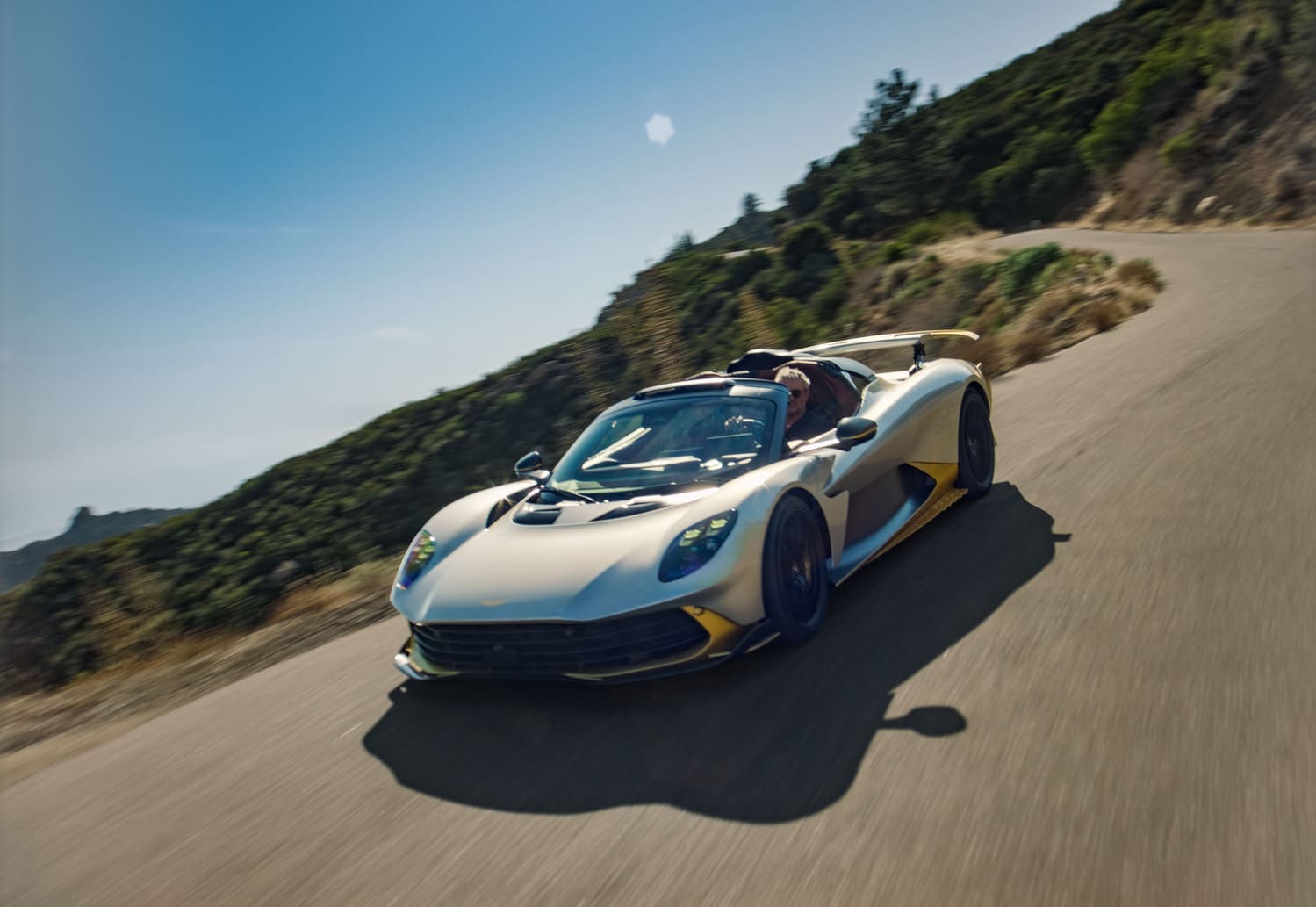

The Aston Martin Valhalla Spider enters the spotlight as an open-top hybrid supercar with numbers that immediately define its intent. The Spider combines 1,079 PS, 350 km/h and a communicated Q2 2025 production start into one of Aston Martin’s clearest modern performance statements.
What makes this news relevant is not just the roofless format, but the fact that the underlying package remains tightly engineered. With a 6.1 kWh battery, a limited run of 999 cars and a 0–100 km/h time of 2.5 seconds, the Valhalla Spider positions itself as a serious technical project rather than a styling exercise.
| Facts & Figures | |
|---|---|
| System output | 1,079 PS |
| 0–100 km/h | 2.5 s |
| Top speed | 350 km/h |
| Battery capacity | 6.1 kWh |
| Total series production | 999 vehicles |
| Communicated production start | Q2 2025 |
Source: Aston Martin Valhalla Spider
Aston Martin Valhalla Spider: open-top, same hard numbers
The Valhalla Spider has always been positioned as a technology-led halo car, but the Spider gives that concept a slightly different edge. Instead of changing the core idea, Aston Martin has opened the car up while keeping the headline figures intact: 1,079 PS, 2.5 seconds from 0 to 100 km/h and a top speed of 350 km/h. That matters, because it shows the open-top format was not treated as a softer lifestyle derivative.
The technical concept remains focused on modern supercar fundamentals. Aston Martin pairs a plug-in hybrid powertrain with a carbon-fibre-intensive architecture, aiming to combine immediacy, stiffness and high-speed stability rather than relying on headline drama alone. For readers who want the factory overview, the official Valhalla Spider page and the Valhalla model page confirm the same central performance numbers.
Technical data: what the Aston Martin Valhalla delivers
The powertrain is one of the most impressive features of the Aston Martin Valhalla Spider. It produces a combined output of 1,079 PS and has a battery capacity of 6.1 kWh. As a result, the Valhalla offers strong performance through its hybrid system. In addition, the electric technology is not only used to improve efficiency. Instead, it also plays an important role in increasing power and improving driving performance.
Furthermore, the Valhalla Spider offers impressive performance figures. For example, it can reach a top speed of 350 km/h. In addition, it accelerates from 0 to 100 km/h in just 2.5 seconds. This shows that the hybrid system improves both acceleration and overall performance. At the same time, the carbon-fibre construction helps support the car’s performance-focused design. Although the Spider has an open roof, it still follows the same engineering concept as the coupé. Overall, the Valhalla Spider combines powerful hybrid technology, lightweight construction and impressive speed.
From reading about it to driving one: the DRIVAR angle
For enthusiasts, cars like the Aston Martin Valhalla are often as much about aspiration as ownership. That is exactly where DRIVAR becomes relevant in practice: if you want to move from reading about rare British performance cars to experiencing comparable machines on real roads or selected event formats, the process is far more accessible than a factory build slot. You choose the format, the car category and the setting, while clear booking steps and structured provider standards keep the experience straightforward.
That does not mean chasing extremes without a safety net. Professional handovers, defined rental procedures and experience-led formats help translate supercar fascination into something tangible and manageable. If British high-performance engineering is what draws you in, DRIVAR’s English sports car selection creates a natural bridge from the Valhalla story to a drive you can actually book.
Production start and why it matters
The timing is almost as important as the specification sheet. Aston Martin communicated Q2 2025 as the production start for the Valhalla, while also tying early customer handovers to the second half of 2025. For a project that has carried substantial expectation for years, that production window is the key fact because it marks the transition from concept-heavy promise to industrial reality.
Exclusivity remains part of the formula as well. Aston Martin has capped the total Valhalla series at 999 vehicles, which gives the Spider immediate significance within a tightly limited program. The number is high enough to make the car a real series-production model, but low enough to preserve the sense that this is a rare piece of the brand’s modern performance strategy.
What this means for Aston Martin
The Aston Martin Valhalla Spider is more than just a powerful open-top sports car. Instead, it keeps many of the important features of the coupé. For example, it combines hybrid performance with carbon-fibre construction. In addition, Aston Martin plans to produce only a limited number of vehicles. As a result, the Spider remains an exclusive supercar. While some open-top models focus mainly on design, the Valhalla Spider also puts a strong focus on performance and technology.
Furthermore, the Valhalla Spider combines open-top driving with impressive technical features. For example, it produces 1,079 PS and reaches a top speed of 350 km/h. At the same time, its carbon-focused construction supports its high-performance design. Therefore, the car offers more than just an exciting appearance. Instead, Aston Martin combines powerful hybrid technology with a strong engineering concept. Overall, the Valhalla Spider offers an impressive mix of performance, exclusivity and open-top driving excitement.
The Aston Martin Valhalla Spider turns open-air drama into a genuinely serious hybrid supercar package.
Conclusion
The Aston Martin Valhalla Spider takes the familiar ingredients of a current-generation hybrid supercar and presents them without losing technical seriousness. Its key numbers are clear, verifiable and strong enough to stand on their own.
More importantly, the concept looks disciplined rather than decorative. With 1,079 PS, 350 km/h and a carbon-focused layout, this is an open-top Aston Martin that still reads like a true performance program first and a style statement second.
Frequently asked questions
What are the key specs of the Aston Martin Valhalla?
The Aston Martin Valhalla is defined by a combined output of 1,079 PS, a 0–100 km/h time of 2.5 seconds and a top speed of 350 km/h. Its plug-in hybrid system uses a 6.1 kWh battery, underlining that this is not just a styling exercise but a serious performance car.
When does Aston Martin Valhalla production start?
Aston Martin communicated a production start for the Valhalla in Q2 2025. The brand also stated that first customer deliveries were due to begin in the second half of 2025, which helps place the program on a clear launch timeline.
How many Aston Martin Valhalla models will be built?
The total production run for the Valhalla series is limited to 999 cars worldwide. That capped volume makes it one of Aston Martin’s most exclusive modern series-production performance cars.
Is there an Aston Martin Valhalla Spider?
Yes. Aston Martin has presented the Valhalla Spider as the open-top version of its hybrid mid-engined supercar. It carries the same core performance message as the coupe, but adds the drama and exposure of roof-off driving.
Sources & further reading
- Aston Martin Valhalla Spider
- Aston Martin Media – Valhalla: The ultimate drivers supercar
- Aston Martin Valhalla
- Wikipedia – Aston Martin Valhalla
- Title Picture: Aston Martin, 2026