
Race tracks are more than strips of asphalt. The best of them combine motorsport history, technical challenge and a sense of place that stays with you long after the engines go quiet. This top 5 ranks the circuits every enthusiast should see at least once.
Some tracks impress with raw speed, others with elevation, mythology or the closeness between fans, cars and landscape. If you want to understand why certain venues have become sacred ground for drivers and spectators alike, these five destinations are the places to start.
5Silverstone Circuit
Silverstone belongs on this list because it represents a key chapter in modern motorsport history. The circuit hosted the first race of the Formula One World Championship in 1950, and its roots go back to a former RAF base where the perimeter roads became a racing venue after the war. That background still gives Race tracks like Silverstone a distinctive feel: part museum, part high-speed proving ground, all substance.
What makes a visit memorable is the blend of heritage and flow. The current Grand Prix layout measures 5.891 kilometers, and even from the grandstands you can sense why fast direction changes such as Maggots, Becketts and Chapel have become reference points for chassis balance and aerodynamic confidence. If you want to read more about the venue’s heritage, the official Silverstone history is worth your time before you travel.
4Autodromo Nazionale Monza
Monza earns fourth place because few venues celebrate speed as honestly as this one. Formula 1 lists the circuit at 5.793 kilometers, and it remains synonymous with long straights, heavy braking zones and a rhythm that rewards commitment more than theatrics. Among legendary Race tracks, Monza feels wonderfully direct: low drag, late braking and a constant sense that every lap should be attacked.
There is also a cultural dimension you can’t replicate elsewhere. Set inside the historic park in Monza, the circuit turns race weekend into a festival of sound and national passion, especially when the Tifosi fill the grandstands. The official Formula 1 track guide to Monza highlights another telling detail: F1’s fastest-ever average lap in practice was recorded here in 2004, which says everything about the place’s character.
3Suzuka Circuit
Suzuka takes third because it offers something purists value deeply: a track that tests the driver in every phase of a lap. The full four-wheel course measures 5.807 kilometers, and its figure-eight layout makes it one of the most recognizable circuits in the world. Unlike many modern venues, Suzuka never feels generic. It demands precision through linked corners and punishes small mistakes without ever losing its flow.
For visitors, that matters because the circuit is exciting even when you are not behind the wheel. You can follow the logic of the lap from the Esses to Spoon and on to 130R, and you quickly understand why so many title fights and defining performances have unfolded here. The official Suzuka course guide is a useful reference if you want to study the layout before visiting, especially if Race tracks interest you as engineering objects rather than just event venues.
2Circuit de Spa-Francorchamps
Spa-Francorchamps is the kind of circuit that reminds you how much landscape shapes motorsport. At 7.004 kilometers, it is the longest track on the current Formula 1 calendar, and that extra distance changes everything: speed perception, weather patterns and the emotional scale of a lap. You do not simply watch Spa, you absorb it. Forest, gradient and history all work together here.
Then there is Eau Rouge and Raidillon, perhaps the most discussed uphill sequence in world racing, but Spa is more than one famous section. The lap keeps asking questions through medium- and high-speed corners, and changing conditions often turn a good race into a classic one. For anyone who loves Race tracks with genuine topography and a strong sense of place, Spa feels essential rather than optional.
1Nürburgring Nordschleife
First place has to go to the Nürburgring Nordschleife because no other circuit carries this mix of challenge, legend and automotive credibility. Opened in 1927, the Nordschleife remains the oldest part of the Nürburgring complex and still defines what a difficult circuit means. Officially, it measures 20.832 kilometers, includes 73 corners and features more than 300 meters of elevation change. Numbers alone do not explain the place, but they show why it stands apart.
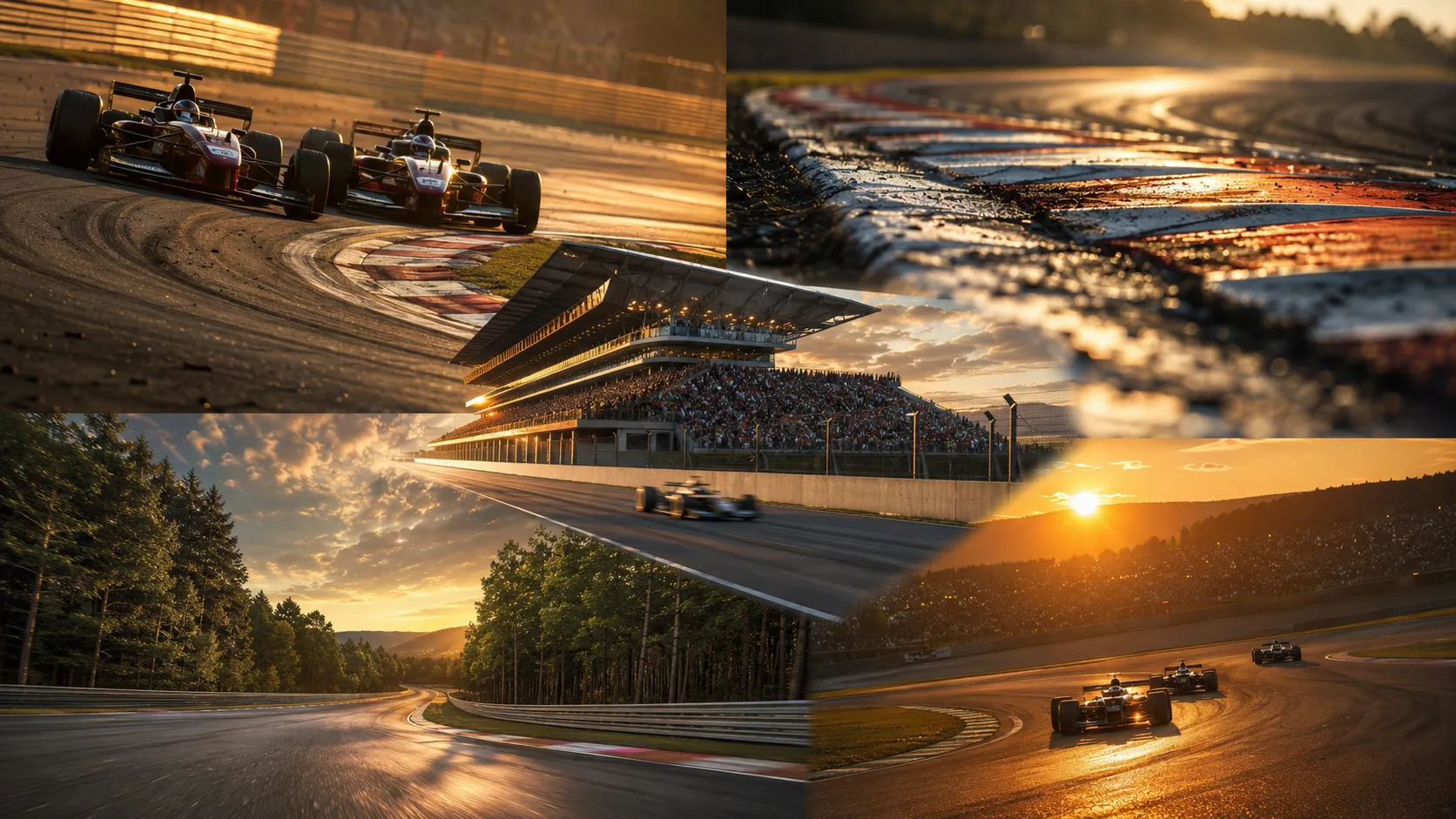
What turns the Nordschleife into a pilgrimage site is the way it connects road cars, racing history and fan culture. Manufacturers still use it as a benchmark, drivers still speak of it with unusual respect, and spectators can feel the scale of the lap in a way television never captures. The image in this article fits that atmosphere perfectly: a track seen not as a stadium, but as a ribbon through the landscape. If you want to understand the myth behind the ‘Green Hell,’ the official Nürburgring Nordschleife page is the best place to start.
How to turn race-track fascination into a real driving experience
The beauty of great circuits is that they rarely leave you satisfied with watching alone. Sooner or later, a proper list of Race tracks leads to the same thought: what would it feel like to drive something truly special yourself? That is exactly where DRIVAR creates the bridge from motorsport dream to real experience, with access to performance cars and curated track-day formats designed for enthusiasts who want more than a static showroom moment.
The process is straightforward. DRIVAR lets you browse exclusive cars online, book with a clear digital process and choose experiences that range from premium road-car driving to dedicated racetrack formats. On the race-car side, DRIVAR also lists structured experiences on German circuits and emphasizes guided formats, professional providers and clear booking steps, which matters if you want excitement without unnecessary uncertainty.
The best race tracks are not just places where cars go fast. They are places where engineering, landscape and history meet.
Conclusion
If you only visit one circuit in your life, the Nürburgring Nordschleife is the strongest argument. But the real lesson from this list is broader: the world’s great tracks are all memorable for different reasons, whether that is Monza’s speed, Suzuka’s rhythm, Spa’s elevation or Silverstone’s heritage.
That is why bucket-list travel for car enthusiasts should always include at least a few iconic circuits. The best Race tracks sharpen your eye for driving, deepen your appreciation of motorsport and make every road car feel a little more interesting on the drive home.
| Facts & Figures | |
|---|---|
| Nürburgring Nordschleife length | 20.832 km |
| Nürburgring Nordschleife corners | 73 |
| Spa-Francorchamps length | 7.004 km |
| Suzuka Circuit length | 5.807 km |
| Monza length | 5.793 km |
| Silverstone hosted first F1 World Championship race | 1950 |
Source: Nürburgring Nordschleife
Frequently asked questions
Which race tracks should every car enthusiast visit at least once?
A strong starting list includes Nürburgring Nordschleife, Spa-Francorchamps, Suzuka, Monza and Silverstone. They cover very different kinds of motorsport appeal, from topography and speed to history and technical complexity. Together, they give you a broad view of what makes iconic circuits special.
What is the most famous race track in Europe?
The Nürburgring Nordschleife is one of the most famous race tracks in Europe, and arguably the most mythologized. Its 20.832-kilometer length, 73 corners and long history have made it a benchmark for both race cars and high-performance road cars. Monza and Spa are also right near the top in terms of cultural significance.
Why is Spa-Francorchamps so popular?
Spa is popular because it combines length, elevation and unpredictable weather in a way few modern circuits can match. At 7.004 kilometers, it feels expansive and dramatic, and corners like Eau Rouge and Raidillon have become part of motorsport vocabulary. It is a circuit that usually produces memorable laps and memorable races.
Can you drive a race car yourself after visiting these tracks?
Yes, and that is often the next logical step for enthusiasts. DRIVAR offers performance-driving and race-car experiences with premium vehicles and structured booking, including track-focused formats on selected circuits. That makes it easier to move from spectator fascination to a controlled real-world driving experience.